Patented & proven solutions
Damp? Musty? Humid? Get a dry, healthy crawl space today!
Get a free estimate
Before & After Photos
Click on a photo to enlarge.
Foundation Repair in Murphy, NC
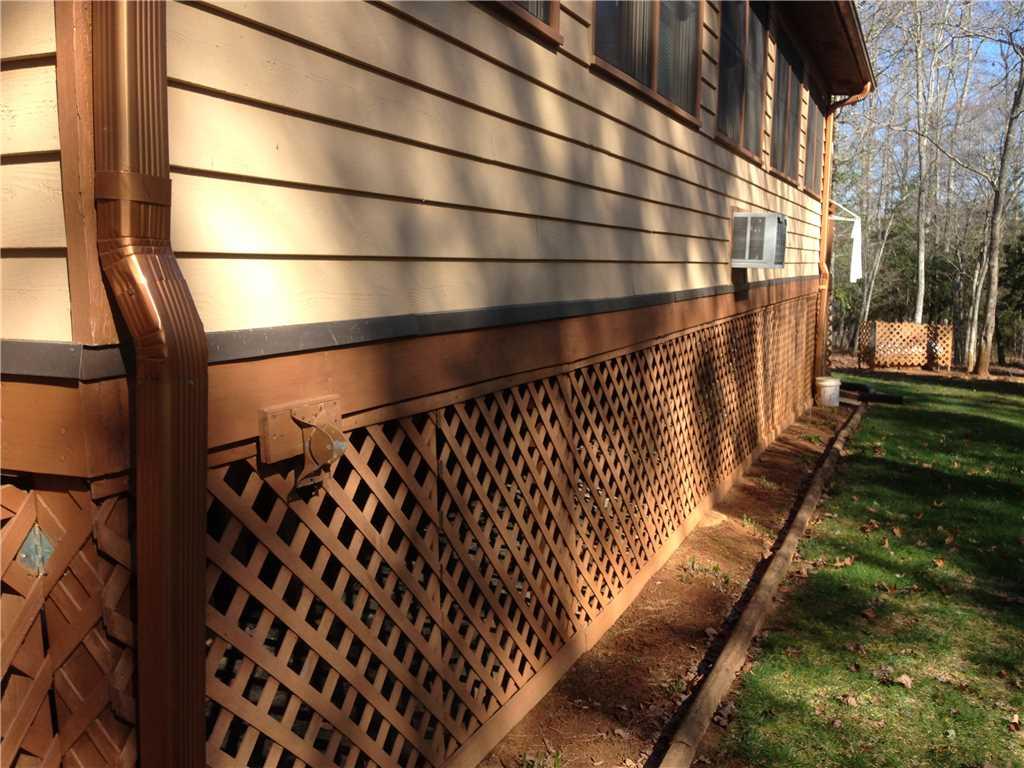

This homeowner was worried that part of their home wasn't being supported how it should be, unfortunately, they were right about that. When our Service Design Specialist Stuart went out to his home, he saw that the home's foundation was starting to crack under the pressure of the extended part of the home. The extra part was only held up by a few thick, wooden beams.
The "before" picture shows what the area looked like before our crew was able to get out to the home and do any work. While it is difficult to actually notice any sagging or other problems in this photo, there are a few places where the wooden posts can be seen through the lattice. While these posts may have worked for awhile, it was only a matter of time before the ground started to shift and these posts caused more problems than they solved.
The "after" photo shows the same area but with the five SmartJacks installed in order to support this part of the home. These SmartJacks were able to provide ample support to this overhanging part of the home. A large part of this job that isn't really seen at all is what we call "supplemental beam", which is basically an extra beam that gives the SmartJacks a connected area in order to disperse the weight evenly between all five SmartJacks.
Huge Crack in Murphy, NC Basement Corrected with Push Piers


Foundation repair is an extremely common problem that we get called out for. However, this homeowner had a crack in their basement wall that was one of the bigger ones that we had seen in awhile. It was impressive that the crack in the wall was able to get as big as this before the homeowner gave us a call to come out and look at their basement. This crack was easily 1-2 inches wide, if not more.
The "before" photo shows what the crack in the wall looked like before any work was done on the basement. As you can see, this crack is very wide, much wider than the rest of the cracks in this basement, and many other homes that we have installed push piers on. Again, the fact the homeowner allowed the crack to get this large is incredible. However, the more impressive thing was how well the push piers brought the crack back together.
The "after" photo is almost unbelievable compared to the before. The push piers did an incredible job on bringing the wall back together. They were able to take a crack with at least a one-to-two inch gap all the way up and reduce the gap to almost nothing. After the two sides of this rift were pushed close to each other, our crew went back and resealed the crack, which will look almost just like the wall when it dries out.
Wall Anchors in Otto, NC Make a Huge Difference on Basement Wall


Foundation issues can be some of the scariest issues that we see and deal with here at All-Dry of the Carolinas. This home definitely did not have as bad bowing walls as many of the other homes that we see here, because the homeowner was proactive about the issues with their home. However, these small cracks will continue to grow if not watched and taken care of quickly.
One of the biggest causes of bowing walls is the pressure that is created on the outside of the home by the earth, as was the case with this particular house. The type of cracking that can be seen in these pictures is a "stair-step" crack, which is one of the more common types of cracking. One of the things that a lot of people wonder about is the duct tape that the crew puts over the cracks. As you can see between the two photos, the duct tape shows how much the wall has moved and came together.
Wall anchors are able to really make a difference in basement walls, especially because they can be progressively tightened. This means that after they are installed, just months later they can be tightened to provide even more support and bring the wall closer to its original position. It can sometimes be difficult to notice how much the wall anchors really do, but the duct tape certainly makes it much more obvious how much the cracks were closed.
Cracking Lakemont, GA Foundation Has Push Piers Installed to Stabilize Foundation


Foundation issues are very serious and can lead to more extensive damage to a home if not taken care of promptly and correctly. There are a number of different foundation issues that can plague a home. One of the ones that we see most often are cracks forming on brick/block foundations. These foundation cracks are usually caused by unstable soil that has settled after the home was built. This is an unfortunate situation but the condition will only get worse as time goes on.
This happened to be the situation that this homeowner was in when they called, however they weren't aware of it. This homeowner actually initially called to have our Specialist take a look because of high moisture levels in the crawlspace (which we were able to fix for them). During the initial inspection, our Specialist noticed some cracks in the foundation around the back side of the home. Our Design Specialist notified the homeowner about the cracks and what we could do to take care of the cracks and provide a stable foundation for the home.
While these photos don't show a great deal of change, the transformation that this home has gone through is quite incredible. There were a total of nine push piers installed on the backside of this home in order to properly stabilize the home and help to take care of the cracks that had formed. In the second photo you can see one of the push piers while the home was being lifted.
Cherokee, NC Home Gets Foundation Settlement Corrected with Push Piers


An issue that we commonly encounter are cracks throughout a foundation. Usually these are smaller cracks, but every once and awhile we get a home that has some pretty serious foundation issues, like this home. As you can see in the before picture, the entire corner of this home was sinking, and pretty significantly. The widest crack is close to an inch wide, which may not seem like much, but for the foundation that supports your home, this is a big deal.
In order to fix this issue, our Systems Design Specialist suggested the homeowner go with a couple of push piers to help bring this corner back towards its original position. The homeowner agreed to get the push piers installed, because he knew how serious this issue could be if left unchecked. Since the settlement was only occurring in this back part of the home, this project only needed two push piers.
The second picture shows the same corner, but after the push piers were installed, and the job was completely finished. As you can see, the crack has been pushed back together and looks completely normal. The great thing about push piers are that, when installed, they are completely covered. This is the perfect example of how we like to work, we want our work to give you all of the benefits of a great system, without having to see it!
